
Heat Pumps for Rural UK Homes: Usage, Benefits, and Costs
What heat pumps are and how they work
A heat pump works on the same thermodynamic principle as a refrigerator, but in reverse. Instead of pulling warmth from an enclosed space and expelling it, a heat pump draws thermal energy from the outdoor environment (air, ground, or water) and concentrates it to heat your home. The process works even in cold weather; usable thermal energy exists in outdoor air at temperatures as low as -25C.
The system relies on a continuous refrigerant cycle through four components. An evaporator absorbs ambient heat, turning a liquid refrigerant into gas. A compressor (powered by electricity) raises the gas’s pressure and temperature. A condenser transfers that concentrated heat into the home’s water-based heating circuit, whether radiators, underfloor heating, or a hot water cylinder. An expansion valve then drops the refrigerant’s pressure, cooling it to restart the cycle.
The measure that matters most is the Coefficient of Performance, or COP. A COP of 3.5 means the system delivers 3.5 kWh of heat for every 1 kWh of electricity it consumes. The remaining 2.5 kWh comes from the environment at no fuel cost. That works out to 350% effective efficiency, compared with roughly 90% for a modern condensing boiler. Over a full heating season, the more realistic metric is Seasonal COP (SCOP), which accounts for varying temperatures. Modern air source units achieve SCOP values between 3.0 and 4.5 depending on installation quality, flow temperature, and insulation levels.
Types of heat pump suited to rural properties
Air source heat pumps
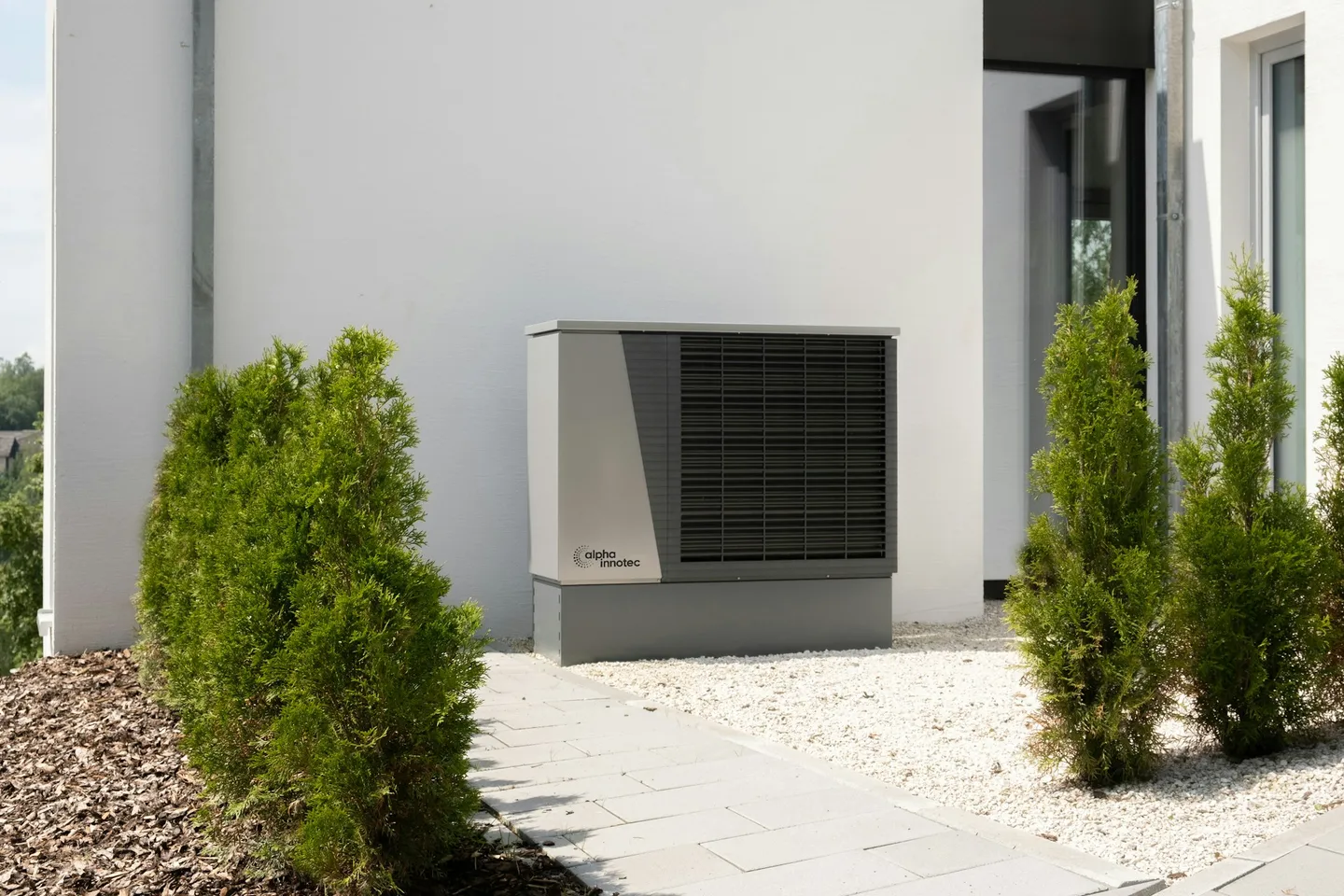
Air source heat pumps (ASHPs) account for 97% of Boiler Upgrade Scheme grants and are the default choice for most UK homes. An outdoor unit, roughly the size of two wheelie bins, draws air across a heat exchanger using fans. Air-to-water models heat water for radiators and hot water cylinders; air-to-air models deliver warm air directly but cannot provide domestic hot water.
Noise levels typically range from 40-50 dB, comparable to a quiet conversation, though premium models such as the Samsung EHS Mono operate at just 35 dB. Modern units continue working down to -15C or lower with only modest efficiency reductions.
Ground source heat pumps
Ground source heat pumps (GSHPs) extract heat from underground, where temperatures remain a stable 8-12C throughout the year. Installation involves either horizontal trenches (pipes laid at 1.2-1.5m depth, needing roughly 2.5 times the property’s floor area in garden space) or vertical boreholes drilled to 60-200 metres. GSHPs outperform ASHPs in the coldest weather when the ground-to-air temperature advantage is greatest. They are virtually silent and well suited to rural properties with available land, though groundworks add considerably to costs.
Water source heat pumps
Water source heat pumps draw heat from lakes, rivers, ponds, or underground aquifers. They achieve the highest efficiency of all types due to water’s superior heat-transfer properties, but they are only viable for properties near a suitable body of water. Open-loop systems require an Environment Agency abstraction licence; closed-loop systems (sealed pipes submerged underwater) are simpler to permit. Roughly 500 are installed annually in the UK.
Hybrid systems
Hybrid heat pump systems pair a smaller ASHP with an existing gas or oil boiler. The heat pump handles most of the heating, reducing fossil fuel consumption by up to 80%, while the boiler supplements output during the coldest periods or for rapid hot water demand. Installation costs are lower (£5,000-£15,000), making them a stepping stone for homes not yet ready for a full conversion. However, hybrid systems do not qualify for the £7,500 BUS grant.
Why heat pumps matter for rural homes in particular
An estimated 4.4 million UK households sit outside the mains gas network, about 15% of all domestic properties. Most are in rural areas, and roughly 78% of off-grid rural homes rely on heating oil, with a further 10% using LPG.
These fuels are expensive and unpredictable. Oil prices surged 117% following Russia’s invasion of Ukraine; in some episodes, 500 litres jumped from £350 to over £600 within a single week. LPG has shown similar volatility, peaking near 90p per litre. Rural fuel poverty rates stand at 15.9%, well above the national average. Beyond cost, oil and LPG involve logistical hassle: regular tank deliveries by diesel lorry, often at short notice during cold snaps when demand and prices both peak.
The policy direction is clear. The UK has legislated for net zero emissions by 2050, with buildings responsible for roughly 30% of national emissions. The government’s original proposal to ban new oil boiler installations in off-grid homes from 2026 has been softened, but the long-term goal remains: phasing out approximately 80% of oil boiler installations by 2035. For new-build homes, the Future Homes Standard, expected fully in force by December 2027, will effectively require heat pumps or connection to low-carbon heat networks, ending gas boilers in new developments.
Rural homes also face particular structural challenges. They are disproportionately older, larger, detached, and built with solid walls that cost more to insulate. Around 8 million UK properties have solid external walls, many in rural locations. Despite this, the UK’s largest heat pump trial, the Electrification of Heat demonstration project with 742 installations, concluded that no property type or architectural era is unsuitable for a heat pump. Four out of five existing UK heat pump installations are already in off-gas-grid homes.
Benefits for off-grid homeowners
Efficiency and carbon reduction
The efficiency gap between heat pumps and combustion boilers is structural, not incremental. An oil boiler converts 85-90% of its fuel energy into heat. An ASHP with a COP of 3.5 delivers 350% effective efficiency. Even accounting for the carbon intensity of grid electricity (roughly 175g CO2/kWh in 2025), switching from oil to a heat pump reduces household emissions by approximately 80%, from around 5,200 kg CO2 per year to about 850 kg. As the UK grid continues to decarbonise toward the 2035 clean power target, heat pump emissions fall automatically each year without homeowner action.
Running cost savings
For a typical annual heat demand of 11,500 kWh, an ASHP on a standard electricity tariff costs approximately £880-£1,100 per year to run. An old oil boiler (70% efficient) costs roughly £1,000-£1,300, and a modern LPG boiler around £1,250-£1,400. Direct electric heating, still common in some rural properties, costs a punishing £2,500-£3,200 per year.
The savings improve further with specialist heat pump tariffs. Rates of 14-21p/kWh (available from providers like Octopus Energy) can reduce annual heating costs to £550-£700. Pairing a heat pump with rooftop solar panels can bring the figure down to £230-£300 per year, a reduction of roughly 70% compared with grid electricity alone.
An important qualification: a January 2026 survey of over 1,000 heat pump owners found 66% reported higher heating costs than with their previous system. This shows that savings depend heavily on what fuel is being replaced, installation quality, correct sizing, and tariff choice. Households replacing old oil or LPG on smart tariffs will see real savings; those replacing newer gas boilers on standard tariffs may not.
Practical advantages
Heat pumps have a lifespan of 20-25 years, matching or exceeding oil boilers, while GSHP ground loops have a design life exceeding 100 years. Annual maintenance costs run at £150-£250, with no chimney sweeping, no fuel deliveries, no oil tank inspections, and no carbon monoxide risk from combustion. Modern ASHPs can also reverse their cycle to provide cooling in summer, and they pair naturally with underfloor heating, which operates at the low flow temperatures (30-40C) where heat pump efficiency is highest.
Costs: purchase, installation, and long-term ownership
Upfront costs
Based on MCS data and Boiler Upgrade Scheme records from 2024-2026, a typical ASHP installation costs £12,500-£13,000 before grants. A 3-bedroom home requiring an 8-10 kW system falls in the £10,000-£13,000 range; larger detached properties may reach £13,000-£18,000. After the £7,500 BUS grant, most households pay £3,500-£7,500 out of pocket. Some providers offer installations from as little as £2,500-£4,000 after the grant.
Ground source systems cost considerably more: £21,500-£29,000 for horizontal trenches and £28,000-£49,000+ for borehole systems. After the £7,500 grant, expect to pay £14,000-£41,500.
Additional costs may include a hot water cylinder (£500-£1,500 if replacing a combi boiler), radiator upgrades (£100-£200 per radiator), electrical supply work (£500-£2,000 for consumer unit upgrades), and insulation improvements. All heat pump installations currently benefit from 0% VAT, saving £1,500-£3,000. This zero rate applies until 31 March 2027, when it reverts to 5%.
Payback periods
With the £7,500 BUS grant applied, payback periods vary a good deal by the fuel being replaced. Replacing an old LPG boiler: 3-7 years. Replacing oil: 5-10 years. Replacing an old gas boiler: 7-14 years. Replacing a modern A-rated gas boiler: 14-18+ years. Solar PV and a smart tariff can shorten these by 2-5 years.
Over a 20-year period, the total cost of ownership tells a clearer story. An ASHP after the BUS grant on a heat pump tariff has an estimated 20-year cost of roughly £21,000, compared with gas at £26,800, oil at £29,000, and LPG at approximately £37,000. This accounts for installation, running costs, servicing, and the fact that boilers typically need replacing once during that period while a heat pump lasts the full 20 years.
Grants and financial support available in 2025-2026
Boiler Upgrade Scheme (England and Wales)
The BUS is the main funding mechanism. It provides £7,500 off the installed cost of an air source or ground source heat pump, £5,000 for biomass boilers (off-gas-grid only), and a newly added £2,500 for air-to-air heat pumps. The grant is deducted directly from the installer’s invoice.
The scheme has been extended to at least 2030, with a budget of £295 million for 2025/26 and total funding of £2.7 billion through the spending review period. Over 100,000 applications have been submitted since launch in May 2022.
Eligibility requires owning the property (including landlords and second homes), having a valid EPC from the last 10 years (this requirement is being relaxed from 2026/27), using an MCS-certified installer, and replacing an existing fossil fuel or direct electric heating system. The scheme is not means-tested. Your installer applies to Ofgem on your behalf, receives a voucher, completes the work, and redeems the grant.
Scotland
Scottish homeowners access a separate, more generous package through Home Energy Scotland. The standard offer is up to £7,500 as a grant plus up to £7,500 as an interest-free loan, totalling £15,000. Rural and island households receive an additional £1,500 uplift, bringing the potential grant to £9,000 and total support to £16,500. Low-income households may qualify for Warmer Homes Scotland, which can fully or partly fund installations for those receiving qualifying benefits.
Additional schemes across the UK
In Wales, homeowners can access the BUS grant and may also qualify for the Warm Homes Nest scheme, which provides free energy efficiency improvements to low-income households with EPC ratings of D or below.
The ECO4 scheme (running until December 2026 across England, Scotland, and Wales) supports low-income and vulnerable households through obligated energy suppliers, covering up to 100% of costs for qualifying households receiving means-tested benefits or with income under £31,000.
In England, the new Warm Homes: Local Grant (launched April 2025, budget of £500 million over three years) provides up to £15,000 for low-carbon heating and up to £15,000 for insulation for homeowners with EPC ratings of D-G and household income under £36,000. This is fully funded with no homeowner contribution.
Installation considerations for rural properties
Planning permission
Since May 2025, ASHPs in England benefit from relaxed permitted development rules. The previous requirement to position units at least 1 metre from the property boundary has been removed. The volume limit per unit has been raised from 0.6 m3 to 1.5 m3, and detached houses can now install two units without planning permission. Installations must comply with MCS 020 noise standards, limiting sound to 42 dB(A) at 1 metre from the nearest neighbour’s habitable room window.
Listed buildings are the main exception. Full planning permission and potentially listed building consent are required, along with conservation officer consultation. Properties in conservation areas and National Parks face restrictions on installations visible from a highway. In Scotland, ASHPs have been permitted development since May 2024 but limited to one unit per dwelling. Wales applies a stricter 3-metre boundary rule.
Ground source systems are generally permitted development across all nations, as they have no visible external impact worth speaking of.
Space and electrical supply
An ASHP outdoor unit needs a clear area of roughly 1,200 mm x 1,000 mm x 400 mm with at least 300 mm clearance on all sides and 1 metre in front of the fan. Indoors, most systems require space for a hot water cylinder (150-300 litres) and potentially a buffer tank. GSHP installations need either substantial garden space for horizontal trenches (600-1,200 m2) or access for a drilling rig.
Electricity supply is a genuine consideration in rural areas. Most domestic ASHPs run on single-phase supply and draw 2-5 kW of electrical input, but many rural properties have older 60A supplies that may be insufficient when combined with other modern loads like EV chargers. A fuse upgrade from 60A to 100A may cost only a few hundred pounds; a full three-phase upgrade averages around £5,370 but can vary a lot depending on distance from the network.
Insulation and heating system compatibility
Good insulation is not required for a heat pump to function, but it makes a real difference to efficiency and running costs. Heat pumps operate most efficiently at low flow temperatures of 35-45C, where COP is highest. Well-insulated homes can maintain comfort at these temperatures. Poorly insulated properties force higher flow temperatures, and every 5C increase in flow temperature reduces efficiency by approximately 5-10%.
A fabric-first approach is recommended for older rural homes: prioritise loft insulation to 270 mm, cavity wall insulation where applicable, and draught-proofing before or alongside the heat pump installation. Solid wall insulation is the most effective but most expensive upgrade (£10,000-£25,000+). Since May 2024, the BUS grant no longer requires insulation improvements as a condition.
Existing radiators can often be retained, but may need supplementing. At heat pump flow temperatures, radiators deliver less output than at boiler temperatures, so some rooms may need larger or additional panels. A professional room-by-room heat loss calculation determines exactly which changes are needed. Underfloor heating is the ideal partner, operating at 30-40C where heat pumps reach peak efficiency.
Choosing the right system and installer
Heat loss surveys and sizing
The single most important step is a proper heat loss survey: a room-by-room calculation assessing wall, roof, floor, and window U-values, ventilation rates, and design outdoor temperature for your location. This is mandatory for all MCS-certified installations and determines the correct heat pump capacity. Most UK homes need 6-8 kW systems; larger, older, or poorly insulated rural properties may need 10-16 kW or more.
Correct sizing matters. An oversized unit short-cycles (switches on and off too frequently), wasting energy and causing premature wear. An undersized unit cannot maintain comfort in cold weather. An estimated 35% of UK installations are oversized due to poor sizing practice, and this is a major contributor to real-world underperformance.
Choosing an installer
Always use an MCS-certified installer, which is mandatory for the BUS grant, permitted development compliance, and quality assurance. MCS certification means the installer holds relevant qualifications, follows MIS 3005 installation standards, and is regularly audited. Find certified installers at mcscertified.com or through the GOV.UK heat pump installer directory. Get at least three quotes, and treat any installer who skips a heat loss survey with scepticism.
Established brands in the UK market
Mitsubishi Electric’s Ecodan range is the market leader with over 15 years of UK track record. New R290 monobloc models deliver COP up to 4.9 with flow temperatures to 75C. Vaillant’s aroTHERM Plus, now manufactured in the UK, uses R290 propane refrigerant and achieves an industry-leading SCOP of 5.03 at 35C flow. Daikin’s Altherma 3 offers one of the highest peak COPs at 5.43 and operates down to -28C.
For rural and off-grid properties specifically, Grant’s Aerona3 is widely recommended. It comes from a UK-based manufacturer with strong merchant distribution and a rural installer network, and is often cited as the best value option for oil boiler replacements. NIBE’s Swedish-made units have the strongest cold-climate heritage and reputation for ground source systems. Samsung offers competitive pricing and one of the quietest units on the market, though aftercare has attracted criticism.
The overriding principle: installer quality matters more than brand choice. A mid-range heat pump installed correctly will outperform a premium unit installed poorly.
Drawbacks and challenges to consider
The electricity price ratio
The most persistent challenge is the UK’s electricity-to-gas price ratio of roughly 4:1 (electricity at 24-28p/kWh versus gas at 6-7p/kWh). For heat pumps to be unambiguously cheaper than gas on a standard tariff, they need a real-world SCOP of approximately 3.5-4.0. Many well-installed systems exceed this, but poorly designed or operated systems with SCOP below 2.5 will cost more to run. The government has begun shifting policy costs off electricity bills but has not yet committed to full rebalancing.
For rural homes replacing oil or LPG, the electricity price ratio is far less of an issue. Those fuels are already expensive enough that heat pumps deliver savings even at modest efficiency levels. Smart tariffs further reduce the concern but require active engagement.
Upfront cost and disruption
Even after the £7,500 grant, an ASHP costs £3,500-£7,500 out of pocket, compared with £2,000-£4,000 for a new gas boiler. Installation typically takes 2-4 days for an ASHP and longer for GSHPs. The EoH project found that 68% of installations required new radiators, 55% needed new pipework, and 72% needed new controls. Only 37% of heat pump installations were completely trouble-free during the process, compared with 76% for gas boiler replacements.
Poorly insulated older homes
While no property type is fundamentally unsuitable, poorly insulated homes force compromises. Higher flow temperatures reduce COP, and undersized emitters leave rooms feeling cool. Pre-1919 rural homes with uninsulated solid stone walls present the biggest challenge, not because heat pumps cannot work, but because running costs may not improve as dramatically without fabric upgrades.
Cold weather performance
The claim that heat pumps do not work in British winters has been thoroughly disproved. During the January 2025 cold snap, 86% of heat pump households reported staying warm, and 9 in 10 said their system performed well. Real-world monitoring shows COP drops to roughly 2.5-3.0 on the coldest days but remains well above 100% efficiency. Most UK winter days sit between 5C and 10C, temperatures where ASHPs achieve their best performance.
The installer shortage
The UK has approximately 3,000-9,000 active qualified heat pump installers against a projected need for 27,000-62,000 by 2028-2035. This shortage contributes to long lead times, inconsistent installation quality, and the wide variance in real-world performance observed across studies.
What real-world UK data shows
The most authoritative UK evidence comes from the Electrification of Heat (EoH) demonstration project, which monitored 742 heat pumps across three regions between 2020 and 2023. The median SPFH4 (the broadest efficiency measure, including all system losses, pumps, and backup heating) for ASHPs was 2.78, meaning the average system delivered 2.78 kWh of heat per kWh of electricity. This is a marked improvement over the earlier RHPP trial from 2011-2014. The project’s conclusion: heat pumps are three times more efficient than gas boilers.
However, the variance between installations is strikingly high, with an interquartile range of 0.50-0.62 in SPFH4. The best-performing quarter of systems far outperformed the worst, a gap explained by differences in design quality, installation standards, and homeowner operation.
More encouraging data comes from the Open Energy Monitor platform, which tracks 252 ASHPs with independent billing-grade metering. The platform average SCOP sits at 3.87, well above the EoH median. This likely reflects the more engaged nature of users who actively monitor systems, but it shows what well-designed, properly commissioned installations can achieve.
Satisfaction surveys are broadly positive. The Nesta survey of 2,549 heat pump owners found at least 70% satisfied across most aspects, with 92% satisfied with safety and 85% with reliability. Running cost satisfaction was lower at 67% but still exceeded the 59% rate among gas boiler owners. Notably, 83% of those who switched from oil and 87% switching from electric heating were more satisfied with their heat pump. The EoH project found 85% of participants would recommend a heat pump to others.
A common theme from user experiences is the learning curve. Heat pumps require a different operating mindset: continuous low-temperature heating with weather compensation, rather than the traditional “blast and boost” approach of gas boilers. Those who adapt report excellent comfort; those who do not tend to underperform.
Market outlook and falling costs
UK heat pump sales reached an estimated 125,000 units in 2025, a 27% increase on 2024. The UK was one of only three European markets to see positive growth while the broader continental market declined. Yet this remains roughly one-fifth of the government’s target of 600,000 installations per year by 2028.
The Future Homes Standard is expected to deliver the biggest boost. By effectively banning gas boilers in new-build homes from 2027, it could triple annual installations. The Clean Heat Market Mechanism (launched April 2025) requires boiler manufacturers to achieve heat pump credits equal to 6% of boiler sales in Year 1, rising to 8% in Year 2, creating further commercial pressure toward heat pump adoption.
On the technology side, three trends will benefit rural homeowners. High-temperature heat pumps now deliver flow temperatures of 65-75C, matching traditional boiler output and reducing or eliminating the need for radiator upgrades. R290 (propane) refrigerant has become the industry standard, with a global warming potential of just 3 (compared with 2,088 for older R410A) and improved low-temperature performance. Smart controls and AI-driven optimisation are enabling heat pumps to respond dynamically to electricity prices, solar generation, and weather forecasts.
UK manufacturing is also growing. 32,920 heat pumps were made domestically in 2024, roughly a third of all sales and up 40% on the previous year. The government’s Heat Pump Investment Accelerator has been tripled to £90 million to support domestic production, with Mitsubishi manufacturing in Scotland, Vaillant investing in a new line in Derbyshire, and Octopus Energy producing units in Northern Ireland.
Costs are projected to fall 20-25% by 2030 as manufacturing scales and competition intensifies.
Summary
For the 4.4 million UK households off the gas grid, most of them in rural areas, heat pumps are the most practical long-term replacement for oil and LPG boilers. With real-world efficiencies of 280-400%, carbon savings exceeding 80%, and 20-year total ownership costs lower than any fossil fuel alternative, the financial and environmental case gets stronger each year.
The strongest returns go to rural homeowners replacing oil or LPG boilers, who face the highest fuel costs and greatest price volatility. Those who combine a heat pump with solar PV and a smart electricity tariff see the best results. Documented annual heating costs below £300 are achievable. The recipe for a successful installation is straightforward: get a proper heat loss survey, use an MCS-certified installer, insist on correct sizing, and invest in insulation improvements where practical.
Challenges remain. Installer numbers are insufficient, electricity pricing relative to gas is still unhelpfully skewed, and upfront costs deter some households despite generous grants. But these are narrowing gaps, not fundamental barriers. With policy mechanisms like the Clean Heat Market Mechanism and Future Homes Standard now in effect, and the BUS extended to 2030, the direction of travel is settled. For rural homeowners still burning oil or LPG, the practical question is increasingly about timing rather than whether to switch at all.